KENYA’s - I.P. REVOLUTIONIntellectual Property ownership is the gateway to a $500 Billion Economy.
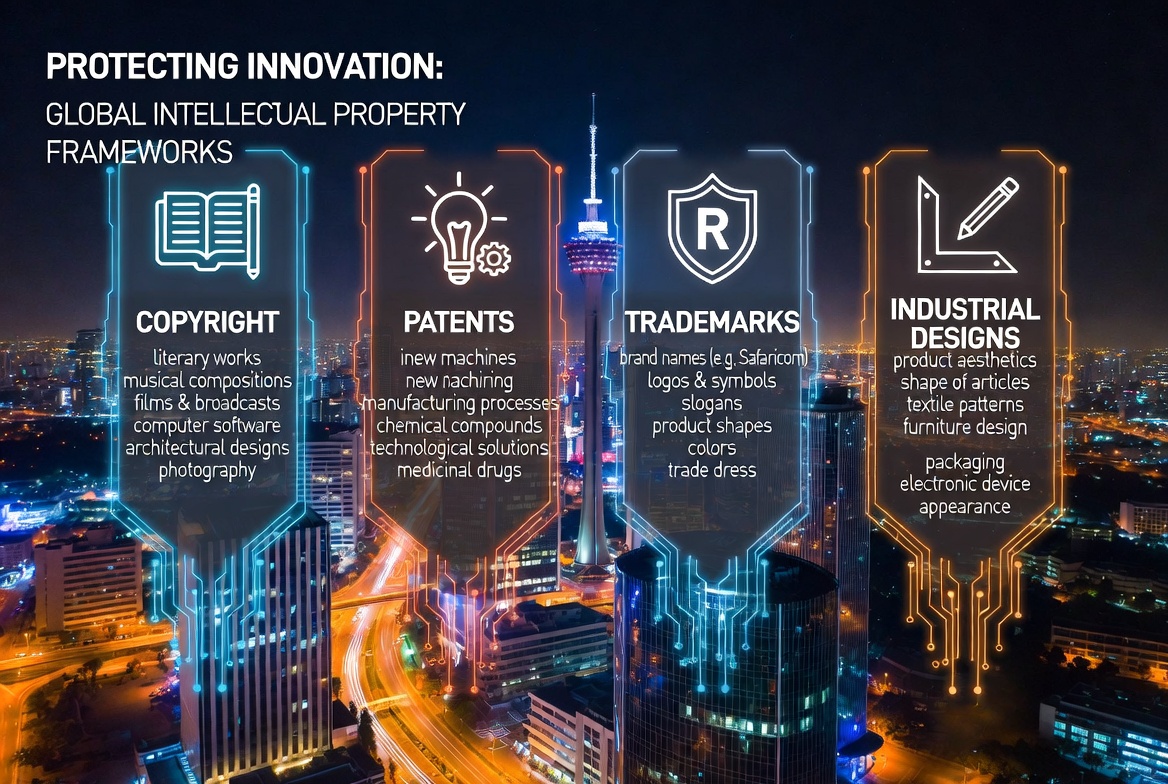
Kenya’s intellectual property (IP) regime remains fragmented across the Industrial Property Act 2001, Trade Marks Act, Copyright Act 2001, and related statutes. Ownership of patents, trademarks, copyrights and related rights is effectively limited to natural persons or incorporated entities. Registered Business Names (sole proprietorships and partnerships under the Registration of Business Names Act) lack clear capacity to hold IP in their own right, creating legal uncertainty, financing barriers and weak incentives for micro, small and medium enterprises (MSMEs).
The I.P. Initiative proposes targeted legislative amendments that would:
- Regularize ownership of IP assets by a registered business name.
- Mandate a maximum 21-day end-to-end registration process on the eCitizen platform through AI-assisted vetting.
- Explicitly classify trade secrets as protectable IP assets.
- Strengthen and clarify “utility patent designs” (building on existing utility models) to protect incremental innovation on existing technologies
Why is this Important ?
1. Supply chains and contract manufacturing
As Kenya moves toward greater contract manufacturing and distributed production, the ability of MSMEs to own and protect their IP becomes strategically important. Where constraints in power generation and capital expenditure make it difficult for every enterprise to build and operate complete production facilities, businesses can instead participate in specialized supply chains—design, formulation, components, packaging, processing, branding, software, tooling and other IP-
intensive activities.
Clear IP ownership gives these businesses an identifiable asset that can be licensed, transferred, valued or potentially used to support financing. The proposal’s recognition of incremental innovation and adaptation of imported machinery is particularly relevant to local manufacturing and agro-processing.
In short: lowering the IP-ownership barrier.
2. Employment and wealth creation
The reform can create a pathway from enterprise → IP ownership → asset value → financing → expansion → jobs and wealth. When a sole proprietor or partnership can hold IP clearly in the “Business name”, the enterprise has a cleaner chain of title and greater ability to transfer, license, value and potentially use its IP as collateral.
That matters because MSMEs can move from operating primarily on cash flow toward building balance-sheet assets. Financing can then support machinery, inventory, production capacity, technology adoption and market expansion—creating employment not only within the IP-owning business but throughout its supplier and distribution networks.
GDP & Macro-Economic Growth.
At the macro level, the objective is to increase the productive capacity of the economy by converting more Kenyan ideas, brands, designs, processes and technological adaptations into commercially usable assets.
The chain is:
IP ownership → investment/finance → enterprise expansion → productivity → production → employment → exports → GDP growth.
This is particularly important because the policy reform is aimed at MSMEs, which constitute a broad base of economic activity. Reducing the cost, uncertainty and complexity of IP ownership can therefore help shift innovation from an intangible idea into an investable economic asset. The policy reform specifically identifies financing barriers, high perceived cost and complexity, and the inability of business-name entities to hold title cleanly as current bottlenecks.
For African trade to become genuinely broad-based, cross-border commerce cannot be driven only by large corporations. Kenyan MSMEs need to be able to own the IP behind products and services, protect their brands, license technology, attract financing and scale across borders.
IP ownership is not simply about protecting an invention. It is about giving African enterprises an asset with which they can finance growth, participate in regional value chains and trade across borders.
The reform is ultimately about moving Kenya from an economy where many MSMEs possess ideas and businesses, but struggle to convert them into recognized assets, toward an economy where IP can be owned by young entrepreneurs, valued, financed, commercialized and scaled.
IP ownership → access to capital → productive capacity → contract manufacturing & supply chains → jobs and wealth → higher GDP → competitive Kenyan enterprises → increased intra-African trade under AfCFTA.